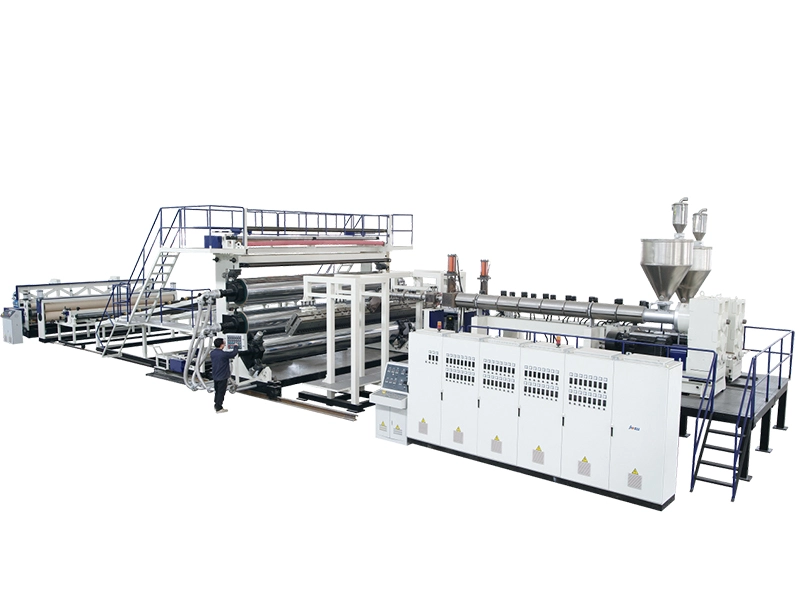
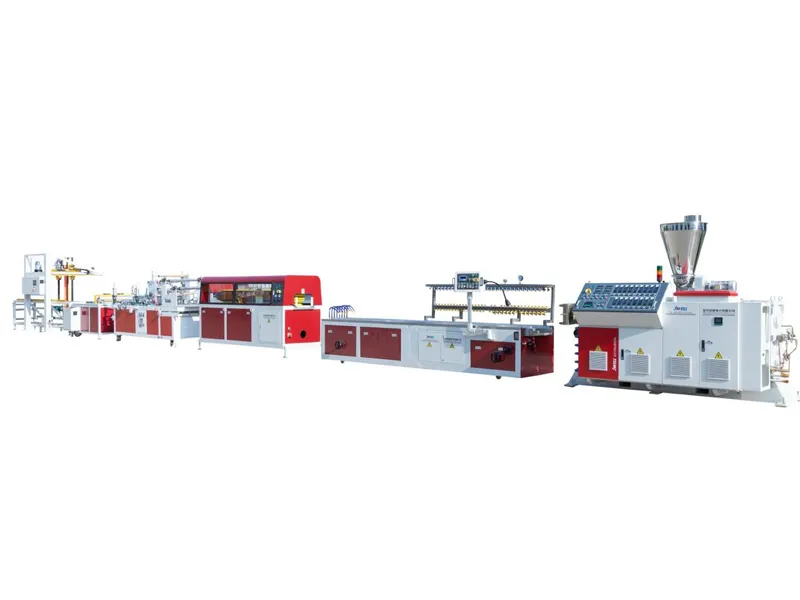
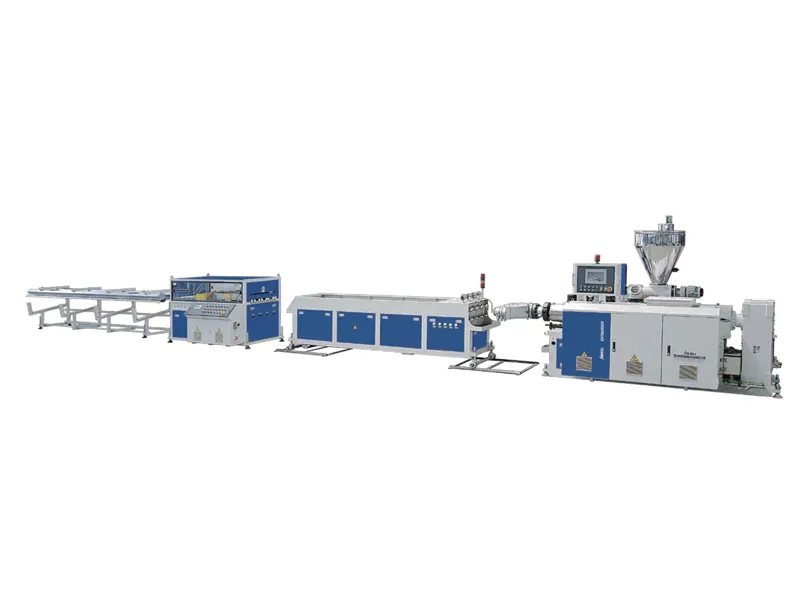
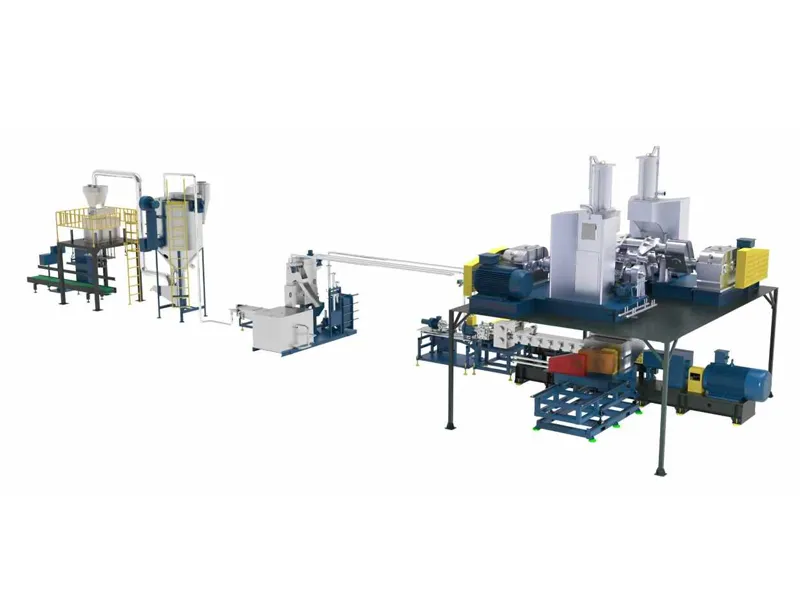
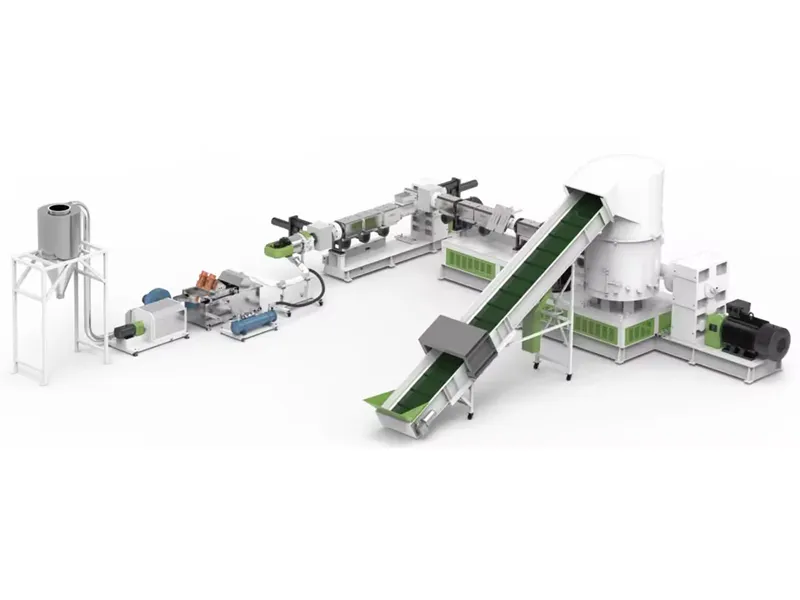
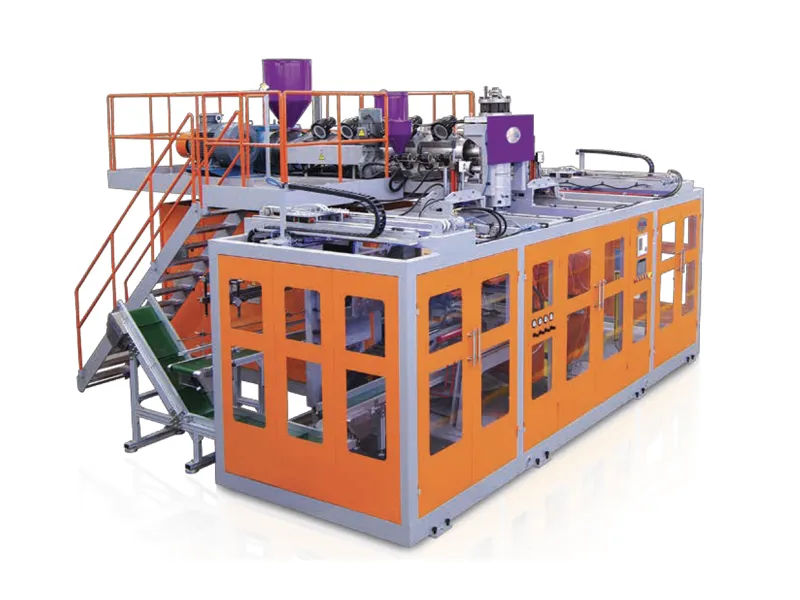
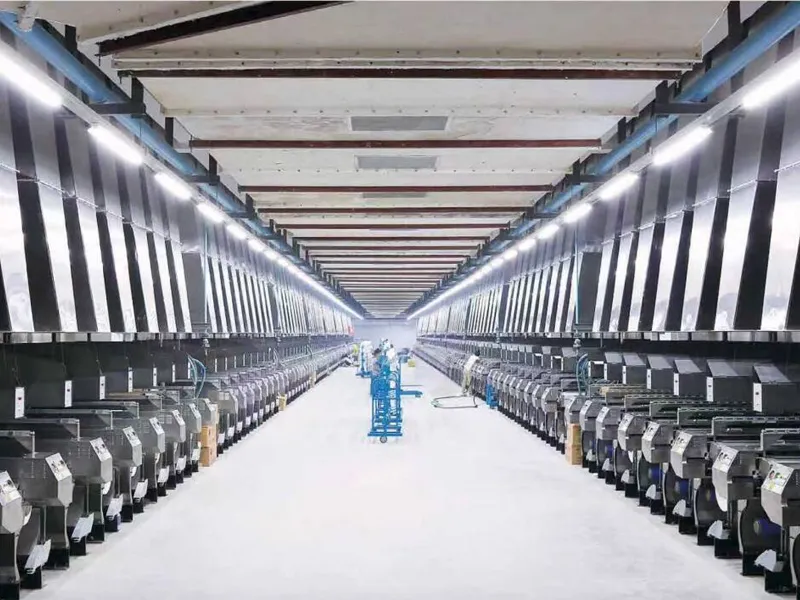
PVC sheet extrusion line vs PS sheet extrusion line is a practical comparison for manufacturers producing rigid sheets, packaging sheets, decorative sheets, refrigerator liners, thermoforming sheets or industrial plastic panels. Both lines melt plastic resin, shape it through a flat die and calibrate sheet thickness through a roll system, but PVC and PS behave very differently in processing, formulation and final use. JWELL provides Plastic Sheet/Plate/Film Extrusion Line solutions for materials including PVC, PET, ABS and polystyrene, with adjustable thickness and width control for sheet, plate and film production. JWELL’s product structure includes both PVC Sheet Extrusion Line and PP/PS Sheet Extrusion Line, helping buyers match equipment configuration to real material requirements.
What Is a PVC Sheet Extrusion Line?
A PVC sheet extrusion line is a production system designed to process PVC compound into rigid or flexible sheet through controlled plasticizing, flat-die extrusion, calendering, cooling, trimming and cutting or winding.
PVC is not usually processed as a simple resin alone. It often requires stabilizers, lubricants, impact modifiers, fillers, pigments or plasticizers, depending on whether the final sheet is rigid, semi-rigid or flexible. Plastics Europe notes that PVC is derived from approximately 57% salt and 43% oil or gas, and is widely used in construction products such as windows, pipes, roofing membranes and flooring. PVC material background
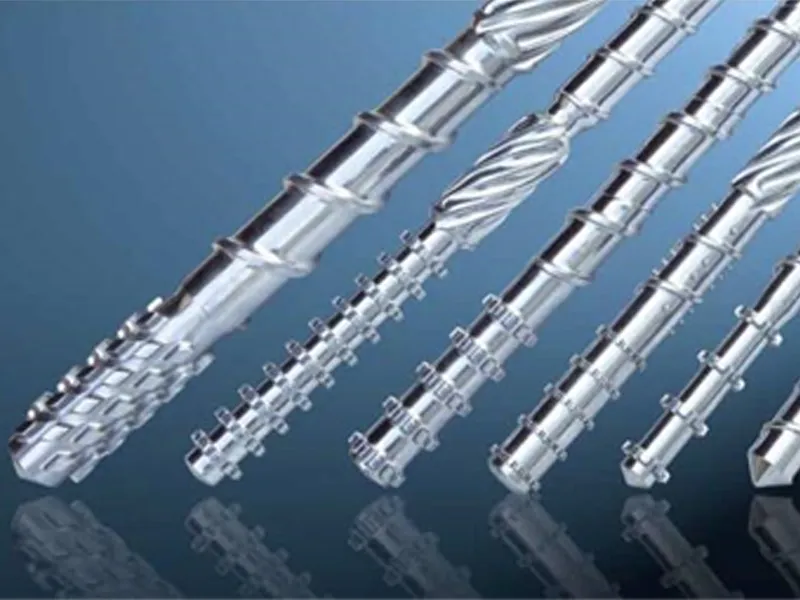
Because PVC is heat-sensitive, a PVC sheet extrusion line usually needs strong temperature control, stable feeding, good venting and screw design that avoids excessive shear. In many PVC applications, a pvc twin screw extruder with a conical or parallel screw configuration is preferred because it can handle powder compounds and additives more effectively than a basic single-screw setup.
What Is a PS Sheet Extrusion Line?
A PS sheet extrusion line is a production system designed to process GPPS, HIPS or modified polystyrene pellets into flat sheet for thermoforming, packaging, display, appliance and industrial applications.
PS sheet production is commonly associated with packaging and thermoforming because polystyrene can be processed into clear, rigid or impact-modified sheet. The British Plastics Federation lists general-purpose polystyrene density at about 1.05 g/cm³, and PS is widely recognized for transparency in GPPS and improved impact strength in HIPS. GPPS material properties
Compared with PVC, PS is usually easier to process from pellets and often uses a single-screw extruder for sheet production. PS sheet lines focus heavily on melt uniformity, die flow balance, roll temperature, thickness stability and thermoforming quality. For HIPS refrigerator liner stock or thick sheet, the line may require higher output stability and stronger cooling capacity.
PVC Sheet Extrusion Line vs PS Sheet Extrusion Line Comparison Table
PVC and PS sheet extrusion lines should be compared by material form, screw configuration, temperature control, application, formulation complexity and downstream process requirements.
| Comparison Item | PVC Sheet Extrusion Line | PS Sheet Extrusion Line |
|---|
| Main Material | PVC compound, rigid PVC or flexible PVC | GPPS, HIPS or modified PS pellets |
| Typical Extruder | Often twin-screw for PVC powder compound | Often single-screw for PS pellets |
| Processing Sensitivity | Higher; PVC needs careful heat and shear control | Lower than PVC, but melt uniformity still matters |
| Additive System | Stabilizers, lubricants, fillers, pigments, plasticizers | Impact modifier or color/additive masterbatch |
| Typical Products | Decorative sheet, construction sheet, rigid board, flooring base, industrial sheet | Thermoforming sheet, packaging sheet, trays, display sheet, appliance liner |
| Main Buyer Concern | Thermal stability, formula compatibility, surface quality | Thickness tolerance, transparency or impact strength |
| Downstream Focus | Calendering, cooling, embossing, lamination, cutting | Calendering, cooling, winding, thermoforming suitability |
| Equipment Cleaning | More sensitive because PVC residue can degrade | Easier material changeover in many cases |
| Best Fit | Construction, decoration, industrial rigid sheet | Packaging, appliance, thermoforming and display |
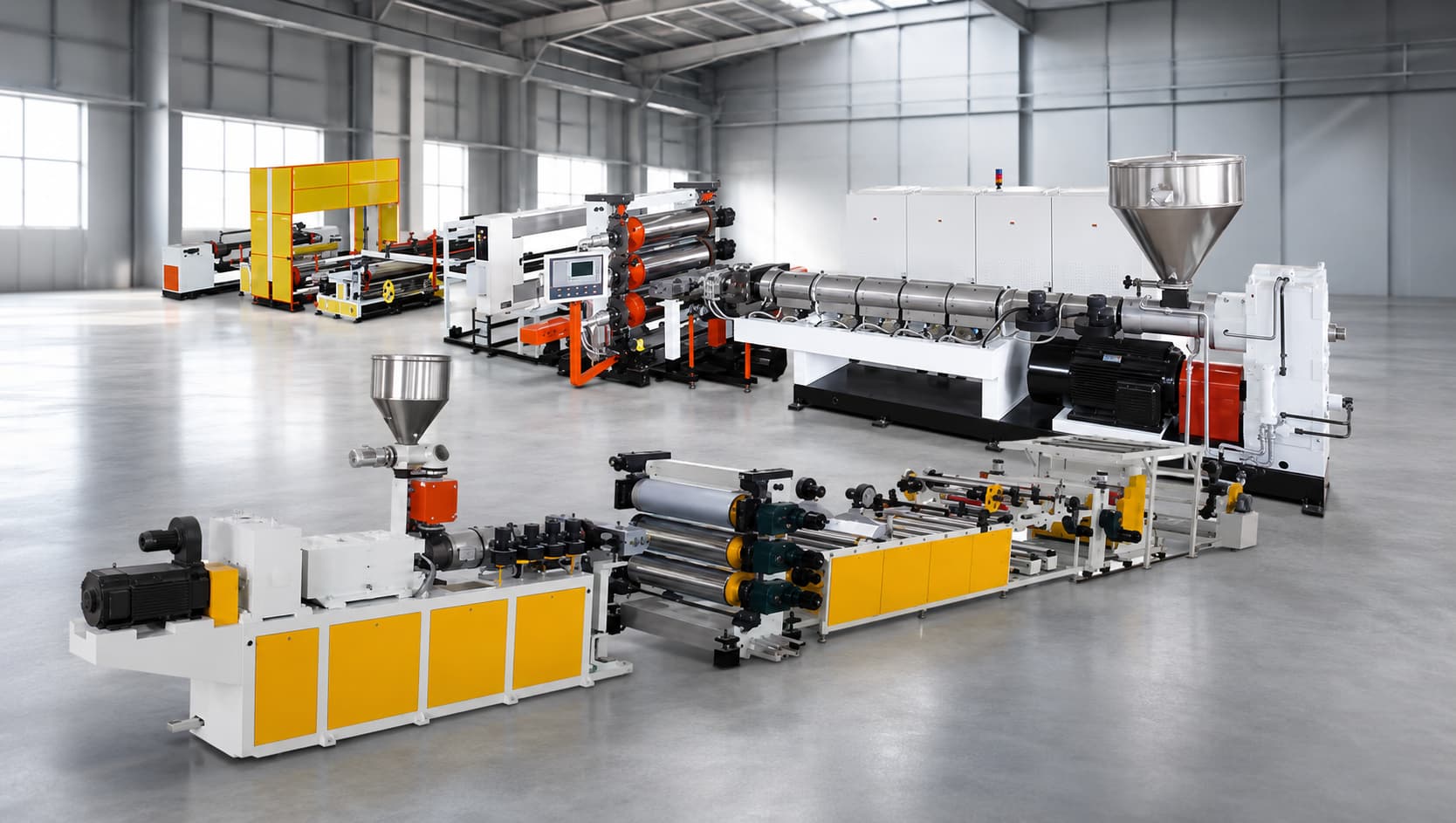
Plastic extrusion itself is a continuous process in which polymer material is melted and formed through a die. The same processing principle applies to a plastic plate extrusion line, although the extruder, die, calibration system and cooling configuration must be selected according to the polymer and final plate specifications. TWI describes plastic extrusion as a normally high-volume manufacturing process using polymer material and additives.
How to Choose Between PVC and PS Sheet Extrusion Equipment
Choosing between a PVC sheet extrusion line and a PS sheet extrusion line means matching the line to resin behavior, finished sheet application, output target, thickness range, formula complexity and downstream processing.
Choose a PVC sheet extrusion line when the product needs flame-retardant behavior, chemical resistance, decorative surface treatment, construction-grade rigidity or PVC-based sheet properties. Buyers should pay attention to screw design, temperature-zone control, stabilizer compatibility, vacuum venting, calender roll precision and corrosion-resistant material-contact parts.
Choose a PS sheet extrusion line when the project focuses on thermoforming sheet, food-service packaging, display sheets, refrigerator liners or cost-efficient rigid sheet. Buyers should prioritize stable pellet feeding, melt pump options, die uniformity, three-roll calibration, winding quality and thickness control.
JWELL offers a broad Plastic Extrusion Machinery for Sale portfolio covering sheet, profile, pipe, compounding, recycling, blow molding and extrusion parts. In addition to PVC and PS equipment, its sheet machinery portfolio includes solutions such as a pc sheet extrusion line for polycarbonate sheet applications with different structural, optical and thickness requirements. Its website also states JWELL produces more than 2,000 advanced extrusion lines every year and has more than 3,000 staff, including about 500 technical engineers and management staff.
For buyers who need help evaluating the whole factory configuration, JWELL can support extruder selection, die design, calender roll system, haul-off, cutting, winding, automation and after-sales service. For project communication, you can contact us to share sheet material, width, thickness, output target and application requirements.
Conclusion
PVC sheet extrusion lines and PS sheet extrusion lines may look similar from a distance, but they are not interchangeable. PVC sheet production is more formulation-sensitive and usually requires stronger control of heat, shear and additives. PS sheet production is often more focused on pellet extrusion stability, thickness uniformity, thermoforming performance and surface quality. For buyers, the best choice depends on the final product rather than the machine name alone. PVC is better for construction, decoration and industrial sheet applications, while PS is better for packaging, thermoforming, display and appliance sheet uses. JWELL provides sheet/plate/film extrusion lines and complete extrusion equipment support to help manufacturers select the correct line configuration for PVC, PS and other plastic sheet materials.
FAQ
1. What is the main difference between PVC and PS sheet extrusion lines?
The main difference is material processing behavior. PVC requires careful thermal control and additive handling, while PS is usually easier to process from pellets and is often used for thermoforming and packaging sheets.
2. Can one extrusion line produce both PVC and PS sheets?
In some cases, limited conversion may be possible, but it is not ideal. PVC and PS usually require different screw design, temperature control, cleaning procedures and downstream settings.
3. Which line is better for thermoforming sheet?
A PS sheet extrusion line is often better for thermoforming packaging, trays and appliance liners, especially when using GPPS or HIPS materials.
4. Which line is better for decorative or construction sheet?
A PVC sheet extrusion line is often better for decorative panels, construction sheets, rigid boards and PVC-based surface products.
5. What information should buyers provide before quotation?
Buyers should provide resin type, sheet width, thickness range, target output, product application, layer structure, surface treatment, cutting or winding method and factory power conditions.
6. Why choose JWELL for PVC or PS sheet extrusion lines?
JWELL provides sheet/plate/film extrusion lines, plastic extrusion machinery, technical engineering support and global project experience, helping manufacturers select suitable equipment for PVC, PS, PET, ABS and other sheet materials.
 English